For many years, I have been fascinated by a simple question:
Can our everyday behaviour reveal the state of our consciousness?
This question became even more meaningful as I practiced Reiki, explored yogic principles, and studied under my spiritual teacher, Gurudeva Sivaya Subramuniyaswami.
The Seven Chakras We Commonly Know
Most people who have explored yoga or meditation are familiar with the seven primary chakras:
- Muladhara (Root)
- Swadhisthana (Sacral)
- Manipura (Solar Plexus)
- Anahata (Heart)
- Vishuddha (Throat)
- Ajna (Third Eye)
- Sahasrara (Crown)
These chakras represent an upward journey of awareness—from survival to spiritual realization.
However, one teaching from Gurudeva profoundly changed how I observe myself and the world around me.
The Seven Chakras Below the Muladhara
Gurudeva taught that there are also seven chakras below the Muladhara, corresponding to the seven talas, or lower worlds. Rather than thinking of these as physical places, he described them as states of consciousness that every human being can experience.
| Chakra | Approximate Location | State of Consciousness |
|---|---|---|
| Atala | Hips | Fear and uncontrolled desire |
| Vitala | Thighs | Anger and rage |
| Sutala | Knees | Jealousy and retaliation |
| Talatala | Calves | Confusion and distorted reasoning |
| Rasatala | Ankles | Selfishness and “me first” thinking |
| Mahatala | Feet | Loss of conscience and moral blindness |
| Patala | Soles of the feet | Hatred, cruelty and destructive intent |
One of Gurudeva’s most important teachings is that these are not labels for people. They are temporary states of awareness.
Awareness rises.
Awareness falls.
The goal of spiritual life is not to pretend we never descend. The goal is to recognize where awareness is and consciously lift it again.
Listening to the Body
Over time, I have noticed something interesting.
Whenever I experience persistent discomfort or heaviness in a particular region of my body, I often pause and ask myself:
“What state of mind have I been living in lately?”
Sometimes the answer surprises me.
- Was I carrying fear?
- Was I reacting with anger?
- Was I thinking only about myself?
I cannot claim this as scientific proof, but I have found this to be a useful practice of self-observation. It reminds me that the body and mind are deeply connected.
Then Came Bengaluru Traffic…
This may sound a little crazy.
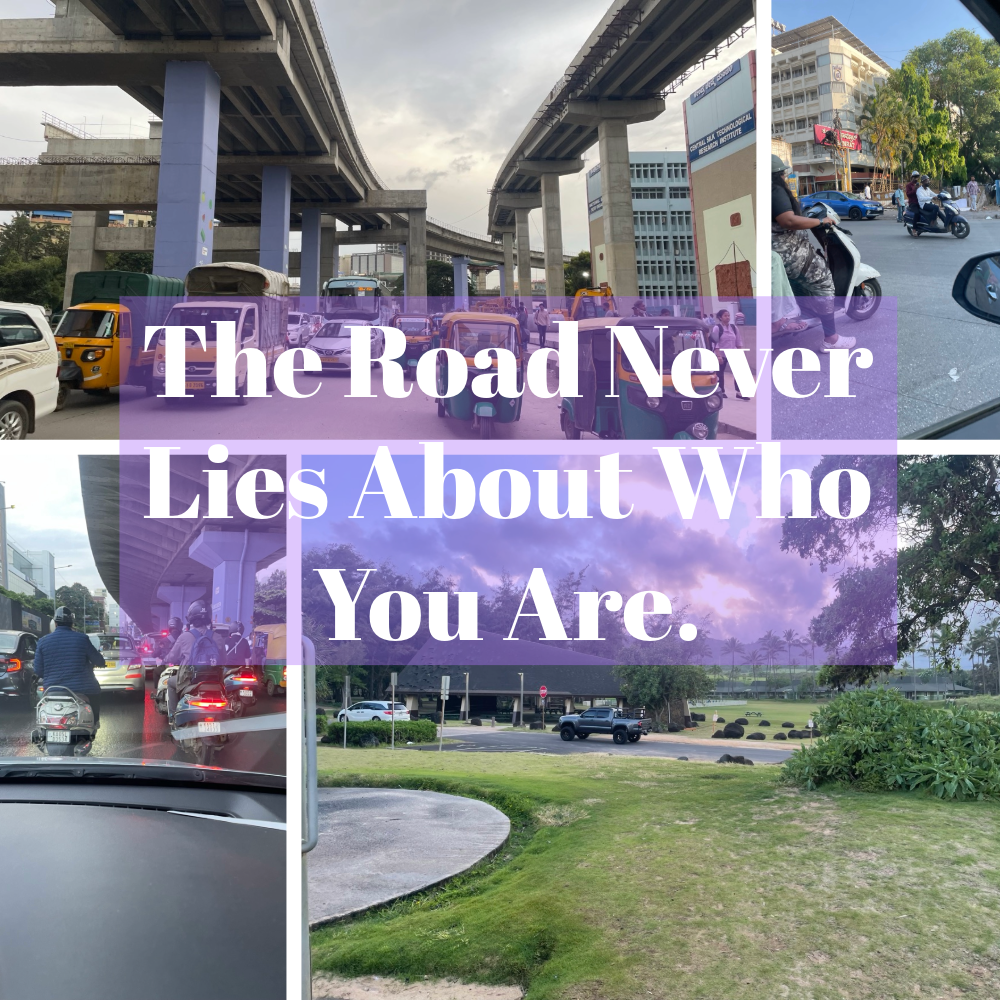
But I often observe traffic—not to judge people, but to understand human consciousness in action.
The road is one of the few places where masks disappear.
At work, we prepare for meetings.
At home, we behave according to our roles.
On social media, we curate our image.
But behind the steering wheel, when nobody knows us, our spontaneous habits emerge.
That is where our awareness often becomes visible.
Traffic Violations as Mirrors of Consciousness
I don’t believe a traffic violation automatically places someone in a particular tala.
Instead, I believe the mindset behind the behaviour reflects the current state of awareness.
Here are a few examples.
🚫 Parking in a No Parking Zone
The thought may be:
“I’ll be back in two minutes.”
“My convenience matters more than everyone else’s.”
This often reflects Rasatala—a consciousness centred around “me first.”
🚦 Jumping a Red Signal
Sometimes it comes from impatience. Sometimes from arrogance. Sometimes from believing that rules are for everyone else.
Again, awareness has momentarily descended into instinctive reaction instead of conscious choice.
🪖 Not Wearing a Helmet
Many people say, “Nothing will happen to me.”
This is not courage. It is often distorted judgment—similar to the confusion Gurudeva describes in Talatala.
🚗 Reckless or Aggressive Driving
Tailgating. Constant honking. Cutting across lanes. Road rage.
These behaviours frequently arise from Vitala, where anger temporarily takes control.
🚧 Blocking Others
Double parking. Blocking entrances. Stopping in the middle of the road.
The underlying message is simple:
“My time is more valuable than yours.”
Again, this reflects a movement toward self-centred awareness.
🛵 Driving on Footpaths
The footpath exists to protect pedestrians. Choosing to ride on it to save a few seconds says something deeper than breaking a traffic rule.
It reveals what we are willing to sacrifice for personal convenience.
The Road Never Lies
One thought keeps returning to me. A person may be exceptionally talented. They may lead large teams. They may speak beautifully about ethics, leadership or mindfulness.
But if they consistently ignore rules designed to protect other human beings on the road, I find it difficult to separate those behaviours from character.
The road asks a simple question:
“What do you do when no one is watching?”
Traffic discipline is not merely about avoiding fines.
It is about empathy. Patience. Humility.
Respect for strangers.
Responsibility for lives we may never know.
A Personal Reflection
I am not writing this because I am a perfect driver. Far from it.
I have made mistakes. I have become impatient. I have reacted emotionally.
The difference is that Gurudeva’s teachings gave me a language to observe those moments without condemning myself. Instead of asking,
“Who is wrong?”
I now ask,
“Where is my awareness right now?”
That single question changes everything.
Living Above the Muladhara
Gurudeva often reminded us that spiritual growth is the practice of keeping awareness above the Muladhara.
Every act of patience lifts awareness. Every act of kindness lifts awareness.
Every act of self-control lifts awareness. Even something as ordinary as waiting at a red signal when no one is watching can become a spiritual practice.
Perhaps enlightenment does not begin in a meditation hall. Perhaps it begins at the next traffic signal.
Because every journey—whether on the road or through life—is ultimately a journey of consciousness.
This article is a personal reflection inspired by Gurudeva Sivaya Subramuniyaswami’s teachings. The associations between everyday behaviours and states of consciousness are my own interpretations intended to encourage self-reflection, not to judge or label others.
The next time you’re behind the wheel, ask yourself:
Am I merely driving—or am I revealing my state of consciousness?
The road doesn’t judge us. It simply reflects us. And every journey offers another opportunity to raise our awareness. 🚦🙏