Can We Stop Being Reactive?
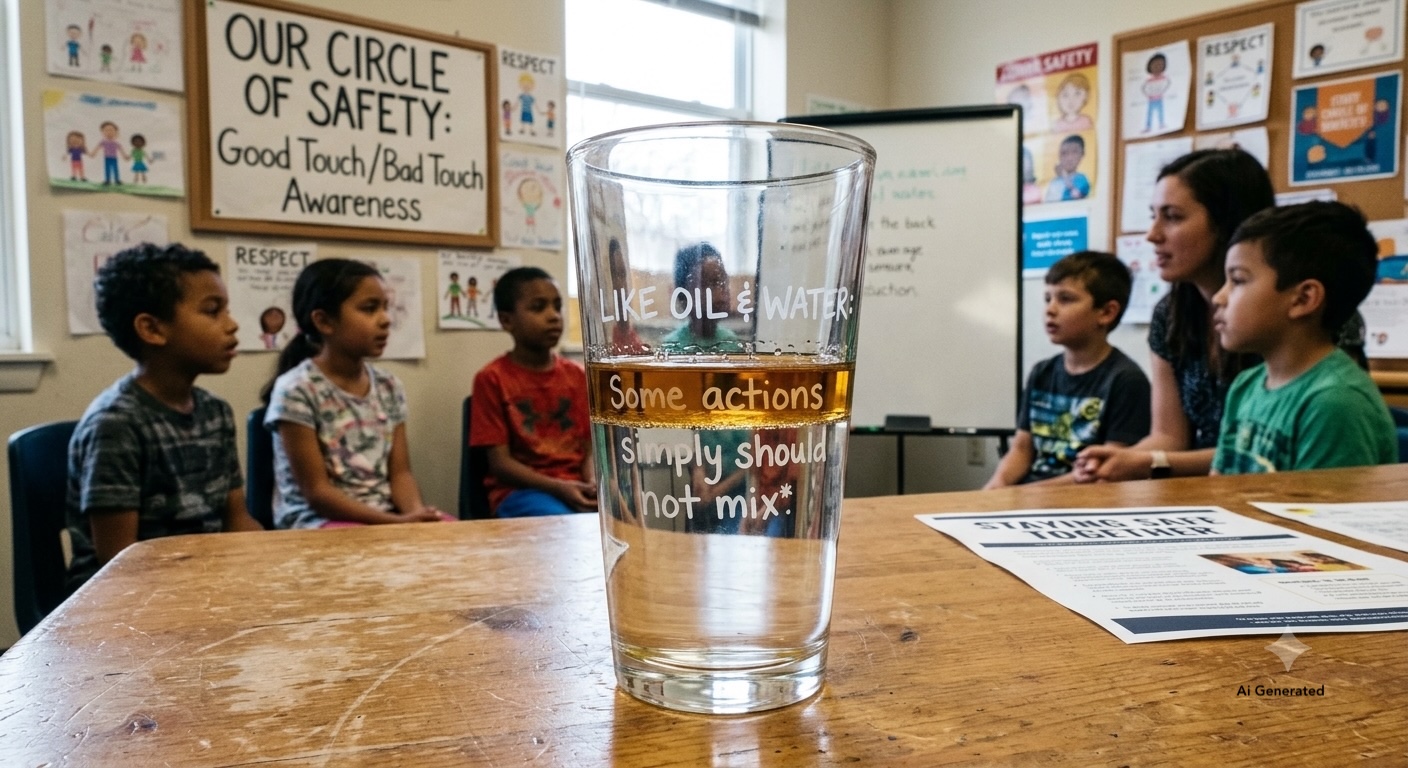
As a parent, I have taught my children, both my boy and my girl, about Good Touch and Bad Touch.
I remember resharing a simple poster many years ago. It explained to children about the private parts of their body and clearly said that no one should touch them there. The chest, the buttocks and the area between the legs.
It was simple.
And sometimes, the most important lessons in life have to be simple enough for a child to understand.
I remember that poster being circulated many years ago, possibly around the time of one of Aamir Khan’s awareness programmes on Doordarshan. Since then, awareness around child safety has certainly improved. Parents and schools speak about it more openly today.
Recently, I watched Bhagavanth Kesari, starring Balakrishna, and its remake Jana Nayagan, starring Vijay. There is a brief but important scene where the hero explains to children what they should do if they ever experience something inappropriate.

The message is simple.
Tell your mother. Tell someone you trust. Do not carry that experience alone.
There was another dialogue that stayed with me. The hero says that he comes from the forest and therefore knows the difference between a human being and an animal.
It made me think.
Every human being has instincts. But being human is perhaps about learning not to become a slave to those instincts.
- Anger.
- Jealousy.
- Lust.
These are emotions and impulses that can exist within human beings. I have written quite a lot about anger. This article is not about pretending that attraction or desire does not exist. They do.
The question is whether we develop the maturity and self-control to ensure that our thoughts and impulses never become someone else’s fear, humiliation or trauma.
The Movie Disadvantage
When I was studying in school, movie posters used to be pasted on walls everywhere.
I remember seeing certain parts of posters painted over with black paint. Movies were clearly categorised, and an “A” certificate itself was enough for many parents and elders to say, “This is not for children.”
We were simply told not to watch them.
Fast forward to today.
Children are exposed to violence, sexualised scenes, double-meaning dialogues and disturbing content much more easily. Sometimes the content is sitting right inside our homes. Sometimes parents themselves take children to movies without considering whether the content is appropriate for their age.
This deeply concerns me.
We teach children about Good Touch and Bad Touch. We teach them about boundaries.
But what are they watching?
What are they hearing?
What are they slowly beginning to normalise?
Children do not learn only from what their parents teach them.
They also learn from what their parents watch, tolerate, laugh at and normalise in front of them.
Their subconscious mind is always observing.
We Should Not Make Girls Responsible for Someone Else’s Behaviour
In traditional Indian families, girls are often given many instructions about how to dress, behave and protect themselves.
Every family is free to teach its children the values it believes in, including modesty and discipline.
But there is one thing we must be absolutely clear about.
A girl’s clothing can never be an excuse for harassment, abuse or inappropriate behaviour.
The responsibility for controlling one’s behaviour belongs to the person who behaves wrongly.
At the same time, we need to consciously raise our boys.
- Teach them boundaries.
- Teach them respect.
- Teach them that another person’s body is not an invitation.
- Teach them that attraction does not give them permission.
- Teach them that “No” means no.
- Teach them that every human being deserves dignity.
Growing up, many of us were taught to look at other women as sisters. Whether we use that cultural expression or another, the underlying lesson is important.
Learn to see another human being as a human being first.
As we celebrate relationships such as Raksha Bandhan, perhaps the role of a brother should not merely be to protect his sister from the world.
It should also be to ensure that he never becomes the reason why another sister needs protection.
My Experience from the Corporate World
This is not only a parenting issue.
I was once part of a review committee in a corporate organisation where workplace harassment concerns could be reported anonymously and reviewed for appropriate action.
I have also personally heard from a close friend about how her manager used to harass her at work. As a friend, I could only encourage her to raise the matter through the appropriate channels and ensure that the organisation took it seriously.
That experience stayed with me.
A child who understands boundaries grows into an adult who understands boundaries. But when respect, consent and self-control are never consciously developed, the problem does not disappear when a child grows up.
It simply moves.
From school to college. –> From college to the workplace. –> From the workplace into society.
A Scene from Chithha
One Tamil movie that deeply disturbed me was Chithha.

The movie shows how predators can manipulate and deceive children. It is uncomfortable to watch, but it forces us to confront an uncomfortable reality. There is also a powerful moment where the heroine questions the everyday experiences of women.
She asks how many men look at her chest while she travels in a bus. How many women silently experience discomfort and humiliation during something as ordinary as travelling.
Then a man passing by asks her:
“Is there any problem, Sister?”
She turns towards him and asks him something along the lines of:
“Anna, are you a yokkiyan? Are you a person without faults?”
The man becomes silent.
That scene made me think.
How often do we point fingers at the obvious criminal while refusing to examine our own thoughts, behaviour, jokes, conversations and actions?
Maybe the problem is not always visible at the extreme.
Sometimes it begins with what society quietly accepts as normal.
Coming Back to Good Touch vs Bad Touch
Here is my question.
Why are we always reactive?
- Why do we wait for an incident?
- Why do we wait for a child to become a victim?
- Why do we wait for a workplace complaint?
- Why do we wait for another horrifying news headline?
Can we prevent?
Of course, we may never be able to eliminate every crime or every harmful person from society.
But can we reduce the possibility?
- Can we raise children differently?
- Can we create safer homes?
- Can we stop normalising things that we know are unhealthy?
I believe we have two problems to tackle.
First, the existing community.
There are people who already display harmful behaviour, violate boundaries and exploit others. Society, workplaces, institutions and the law must identify such behaviour and respond appropriately.
We cannot simply say, “This is how the world is. Move on.”
That is not being practical. That is being irresponsible.
Second, the next generation.
This is where parents have an enormous responsibility.
Parents need to create a safe zone at home.
- A child should be able to ask a difficult question without being shouted at.
- A child should be able to talk about something uncomfortable without being ashamed.
- A child should be able to say, “Something happened,” without first worrying about whether their parents will blame them.
Please do not become so busy that your children stop coming to you with their questions.
One day, they may stop asking.
And when that happens, the internet, social media, friends or strangers may start answering them instead.
What Are We Feeding the Young Mind?
Children have enormous energy.
- Curiosity.
- Creativity.
- Imagination.
The question is where that energy goes.
Are we helping them discover sports, books, music, art, spirituality, science and meaningful friendships?
Or are we allowing every empty moment to be filled with endless scrolling, reels and content selected by an algorithm designed to keep them hooked?
Parents need to have conversations about self-control, respect, relationships, attraction and personal boundaries.
Not with fear or shame.
But with honesty.
I also strongly believe that families should consciously create spaces for reflection.
Importance of Temples

For many Indian families, visiting a temple once a week can be one such space. It is not merely about asking God for something. It can become a pause from the constant noise of life.
A moment to sit quietly.
A moment to reconnect with family.
A moment to reflect.
Whether we understand it spiritually, psychologically or culturally, children need spaces that pull them away from constant stimulation and bring them back towards reflection and positive habits.
What Happened to Us?
When I think about the larger society, I sometimes wonder how and why we lost our track.
Unlimited internet access. Smartphones in every hand. OTT platforms. Social media algorithms designed to keep us engaged.
Easy access to content that was once difficult for children to reach.
The problem is not technology itself.
Technology can educate. It can connect. It can create opportunities. But technology without boundaries can also expose young minds to things they are not ready to process.
We need better parental awareness.
We need stronger age-appropriate protections.
We need platforms to take child safety seriously.
And yes, governments and institutions also have a responsibility to seriously address the easy access of children to pornography, illegal drugs and other harmful content.
Freedom cannot mean abandoning responsibility.
The Real Prevention
Teaching a child Good Touch and Bad Touch is important. Please do it.
- Teach them about private body parts.
- Teach them that they have the right to say no.
- Teach them that secrets involving their body should not be kept.
- Teach them whom they can approach.
But let us not stop there.
- Let us also teach our children what respect looks like.
- Let us teach them boundaries.
- Let us teach them self-control.
- Let us teach our boys that strength is not about domination.
- Let us teach our girls that they are never responsible for another person’s wrong behaviour.
- Let us teach every child that another human being’s dignity is not something to be negotiated.
And above all, let us create homes where children can speak.
Because the long-term solution is not merely to raise children who know how to identify danger.
We need to raise a generation that does not become the danger.
That, to me, is where the conversation on Good Touch vs Bad Touch should eventually lead us.
Get HabitZup – Strategy Game for Life to practice decision making and positive habits at home